Common Questions
Brimfield FAQ
Answers compiled from dozens of real visitor accounts and firsthand reporting — not just organizer talking points.
How often does Brimfield happen?
Three times a year — May, July, and September — each running roughly Tuesday through Sunday. See our show dates page for the current schedule.
Is there more than one "Brimfield" show?
Yes, and it's a genuinely common mix-up. The real, original show is the Brimfield Antique Show/Flea Market in Brimfield, Massachusetts, running May/July/September. There's also a separate "Traveling Brimfield Antique Show" that visits other states (it's been seen in the Adirondacks, NY) and is much smaller — one visitor described it as roughly 125 vendors versus thousands at the real show. And there's a distinctly different, unaffiliated "Brimfield Antique Show" event held in Sturbridge, MA in January — several people researching Brimfield have run into this by accident. If you're planning a trip, double-check the location is actually Brimfield, MA on Route 20.
Do all the fields open on the same day?
No. Brimfield is 20+ independently owned fields, and each sets its own opening day and time across the week — some open at sunrise Tuesday, others not until Wednesday, Thursday, or later. If a specific field matters to you, check its individual schedule rather than assuming it's open on day one.
Do I really need to arrive at 5am to get anything good?
No — this is one of the most repeated myths, and multiple experienced visitors have called it out directly as exaggerated "influencer" advice. Several people arriving around 7:30–8am independently reported plenty of parking still available and no trouble getting in. "Arrive early" matters more for a specific field's own opening time than for the day as a whole.
How many days should I plan for?
More than one, if you want to see a meaningful amount. It's a near-universal theme across visitor accounts — even people who've been going for years, and even a field organizer, put realistic full coverage at 3 to 5 days. Most first-timers do fine with 2 days and accept they won't see everything.
Can I negotiate prices?
Yes — it's expected, not rude. A fair starting expectation is somewhere around 10–25% off an asking price, more if you're buying multiple items from the same vendor (bundling is consistently the best way to get a real discount). Some vendors hold firm on fair prices, and that's fine too — you're always free to walk away, and sometimes that alone brings a better offer.
Do vendors take cards or Venmo?
Cash is still the safest assumption, and plenty of vendors are cash-only. That said, accounts genuinely conflict on the details — some visitors report Venmo and card readers working fine at many booths, others say "nobody does Venmo, they take checks" instead. Both are probably true simultaneously across thousands of independent vendors. Bring cash, consider a checkbook as backup, and don't assume any specific payment method will work at any specific booth.
How much is parking?
Typically $5–$20 depending on the lot and how close it is to the fields, almost always cash. Prices can also vary by day — the same lot has been reported at $5 on a quiet day and $20 on a show's opening day.
Is there an entrance fee?
Most fields are free. A handful charge a small fee, commonly $5–$12, usually only on their opening day or opening hours — the idea being to guarantee early buyers first pick of fresh inventory.
Do I need a cart or wagon?
Bring one if you can. It's the single most repeated piece of practical advice across every kind of visitor — casual shoppers, dealers, and everyone in between. A cart or wagon with real, sturdy wheels handles mud, gravel, and grass far better than a bag alone; standard small plastic wheels tend to get stuck or dragged rather than rolled. Just know that not every booth aisle is wide enough for one, and an unattended cart outside a tent is worth keeping an eye on.
What should I pack?
Cash (small bills), comfortable closed-toe shoes that can handle mud or dust, sunscreen and a hat, layers (mornings run cool, afternoons get hot), water and snacks, hand sanitizer or wipes, a tape measure, and a cart or bag for purchases. If you're hunting anything you already own and want to match (silverware, fabric, etc.), bring a photo of it.
Can I bring my dog?
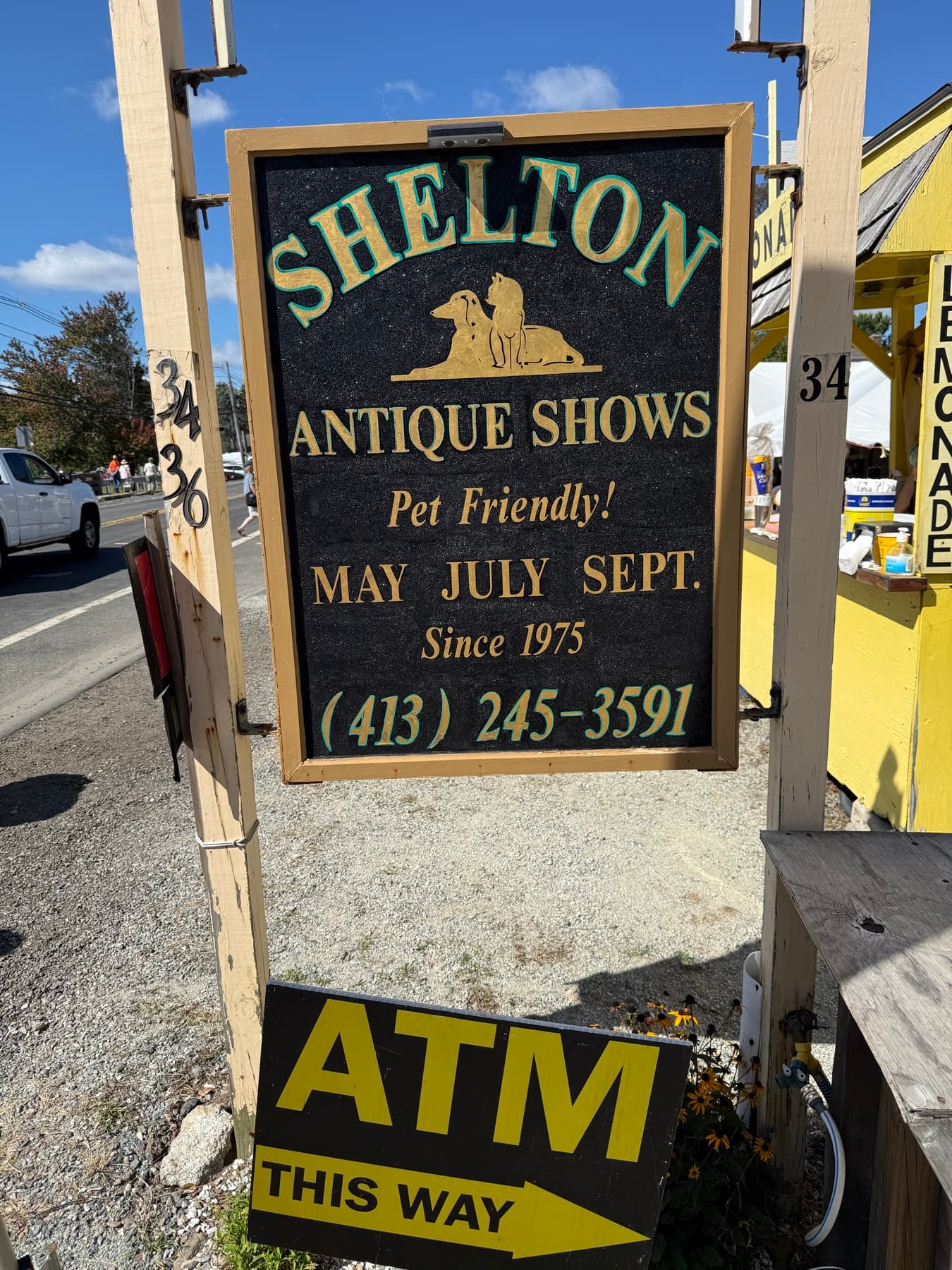
Generally yes — most fields welcome dogs, with occasional exceptions at specific fields or parking lots that post no-pets signs. If you bring one, treat the day like you would for yourself: bring water, watch for heat stress (dogs show it later than you will), and skip it if your dog doesn't do well with crowds.
What happens if it rains?
The show is rain or shine, and it does happen — fields are unpaved, so expect mud. Some vendors pack up early on a rainy day, but plenty stay open, and a few visitors specifically look for rainy days because crowds thin out and vendors get more willing to deal. If you go, waterproof boots are worth it.
Is Brimfield actually good for bargains?
It's genuinely mixed, and worth going in with realistic expectations. You'll find real deals, especially on bundles, at the end of a field's run, or from vendors motivated not to repack inventory — but plenty of items are priced at or near retail, and some visitors (especially resellers) have found prices comparable to or higher than eBay. It's less "everything's a steal" and more "the deals are there if you're willing to look and negotiate."
What if I buy something too big to carry?
Ask the vendor to mark it "sold" and hold it while you keep shopping, or use one of the informal porters who work the fields to move it to your car — porters negotiate their own price per job, there's no fixed rate. See our logistics guide for more detail.
Where should I stay?
There's very little lodging in Brimfield itself. Sturbridge is the closest town with real hotel capacity, though it books up fast and fills first. Auburn, MA is a bit further but often has more availability and better rates. Book ahead — this isn't a same-week-booking kind of trip during a show.
Which show is best — May, July, or September?
May and September tend to draw the biggest crowds and the most vendors. July runs hotter, and multiple sources describe it as the smallest of the three shows — some vendors skip it specifically because of the heat. If crowds and heat both bother you, July with an early arrival can actually be the most comfortable option.
Is there food on-site?
Yes, extensively — food trucks and stands throughout the fields. Recurring favorites mentioned by name: the "pilgrim sandwich" (a turkey, cranberry, and stuffing sandwich), Dell's frozen lemonade, and an Italian sausage-and-peppers stand near one of the fields. Lines can be long at peak times, so packing your own water and snacks isn't a bad idea.
Is it worth going if I'm not a serious antiques collector?
Yes — this comes up a lot, and the consistent answer from casual visitors, families, and even non-collectors tagging along with someone else is that the scale and atmosphere alone make it worth experiencing, independent of whether you buy anything.