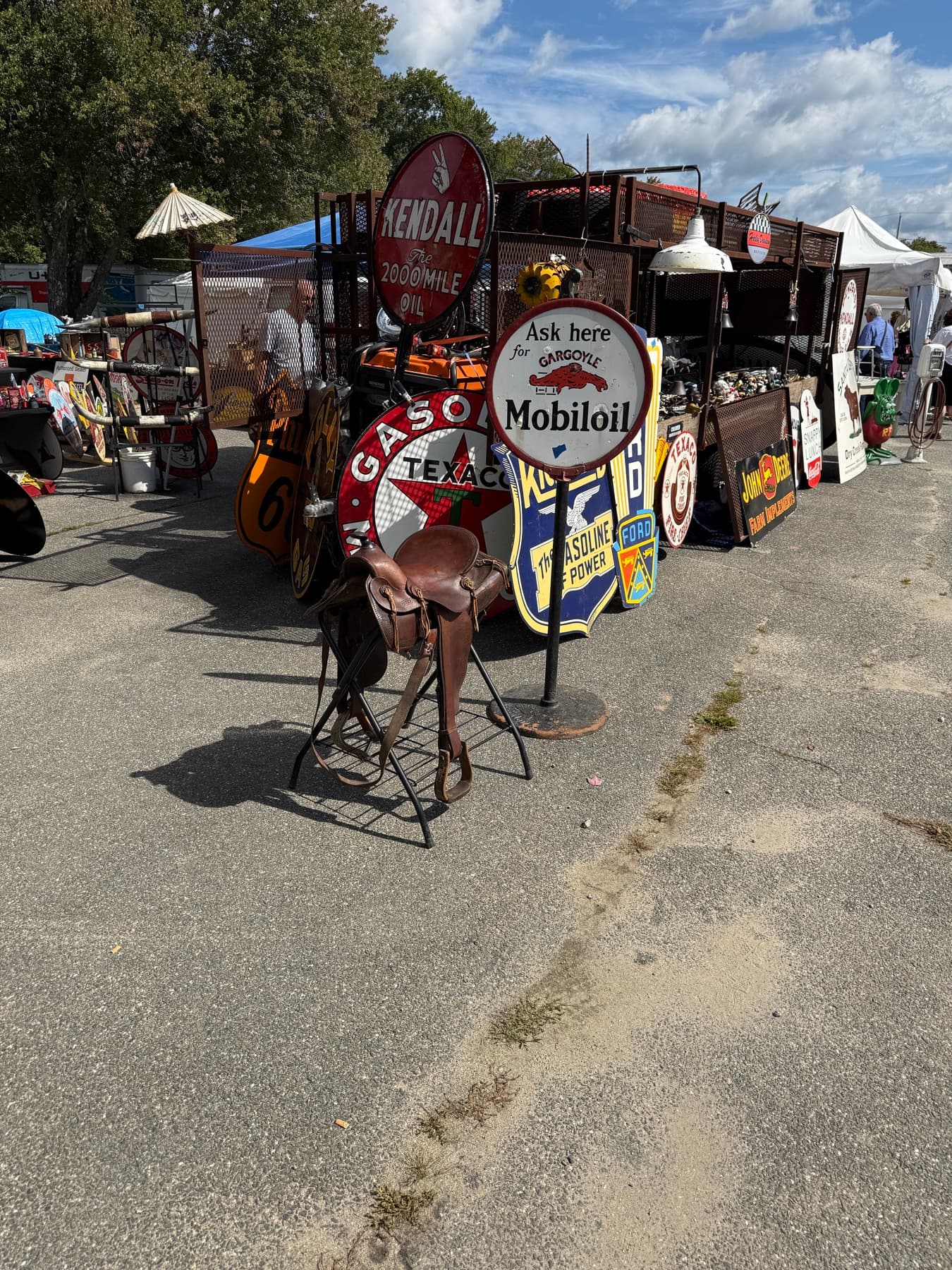
Brimfield isn't one antique show. It's more like twenty of them happening at once, in the same small Massachusetts town, three times a year — and almost nobody involved agrees on exactly how big it really is.
It started with one man's front yard
In 1959, a Brimfield auctioneer named Gordon Reid held the first show on his own Route 20 property — 67 dealers, one field, one weekend. Reid and his wife Madelyn wanted Brimfield to become the antiques capital of the country. It worked, arguably too well: the original field, later named Auction Acres, reportedly grew to around 700 dealers with a two-year waiting list to get a booth. When Reid died in 1974, his daughters Judy Reid Mathieu and Jill Reid Lukesh took over the show under the name J&J Promotions (today it operates as Brimfield Auction Acres).
Demand kept outpacing what one field could hold, so neighboring landowners started opening their own fields to dealers. That's the origin of the sprawl that exists today: 20+ independently owned and operated fields, each with its own promoter, own opening day, own admission policy, and own dealer roster. There has never been one company running "Brimfield" — and there's no sign that's going to change.
The show, in practice
Brimfield runs three times a year — May, July, and September — each stretch spanning six days, Tuesday through Sunday. See our show dates page for the current schedule.
But "the show" doesn't open all at once. Individual fields open on different days and times across that week — some at sunrise Tuesday, some not until Wednesday afternoon or Thursday morning. As Brimfield Antiques Center owner Lori Faxon put it: "For those three weeks, we pretty much overtake the town."
Nobody agrees on how big it actually is — and that's structural, not sloppy
This is the single most important thing to understand before citing any number about Brimfield: there is no central organizer, so there is no combined headcount. Every figure below is somebody's estimate, and they disagree by a wide margin:
- Fields: most sources land on 20–21, though counts as low as 19 and as high as 22 show up depending on the year and who's counting.
- Dealers: anywhere from "thousands" up to 6,000+, with individual fields alone sometimes hosting 400+ dealers each.
- Weekly attendance: estimates range from roughly 50,000 up to 100,000+, and annual estimates run from 130,000 to over 250,000.
None of this is dishonesty on anyone's part — it's the direct consequence of 20+ separate businesses each running their own show with no shared ticketing or counting system.
The town itself
Brimfield, MA has a population of roughly 3,700 people. During a show week, that number effectively multiplies many times over — even the most conservative attendance estimates mean the town's population increases by an order of magnitude for six days, three times a year, then returns to normal.
It's not standing still — and the people running it know it
In an on-camera interview, a dealer who identified herself as Clea Veritus, "CEO of Brimfield Antique Show," made a point of correcting the outsider's assumption that vendors "only work 3 weeks a year": "All year long we're looking for vendors, we're marketing, we're talking to people. It's a lot of work, but it's great fun." She also described the show in terms that go well past commerce: "This is more than just a flea market, it's a lifestyle... people who come here want their ashes spread here when they die."
Multiple longtime dealers in the same interview series described real structural change in the show over the years — not just growth, but a shift in what it is:
- "Clothing's a lot more popular... it's definitely kind of a clothing show at this point."
- "Back then it used to be you'd get people who would travel to Brimfield looking for objects they didn't find anywhere else... now the market's kind of changed to where it's a lot more dealers not setting up, just coming to buy for as cheap as possible to resell. It's no longer the antique show but more of like a flea market kind of thing."
- COVID specifically accelerated this: "It created tons of new resellers... the first two, three years of COVID the market was just way too saturated with resellers."
- One dealer's framework for reading the show's health: a "white hot theory" — once you start seeing a single category in every booth, "that's kind of the beginning of the end" for that trend.
A real link worth mentioning
One vendor interviewed on-site, Danny of Round Top Antique Auction (Carmine, Texas), does both shows: "We're trying to just do the three Brims and the three Texases... y'all come see us in Texas as well." He described a 3,000 sq ft brick-and-mortar shop back in Texas and said he's "been in Brimfield for the best part of 30 years."
He's not alone — plenty of serious buyers and dealers do both shows every year. If Round Top, Texas (America's other giant antique show) is on your radar too, Round Top Finder is our sister site built the same way — real venue data, a live map, and an honest Round Top vs. Brimfield comparison if you're trying to decide which to hit first.
A note on this post: this is compiled from published sources and on-record interviews. We've since visited Brimfield in person (September 2026); this specific history-and-scale content predates that trip and hasn't been individually re-verified against it yet.
Never Miss a Show
Get show dates, field guides, and trip-planning tips delivered to your inbox. Monthly, never spammy.
Not ready to subscribe? Grab the free printable cheat sheet — no email required.